
Abstract
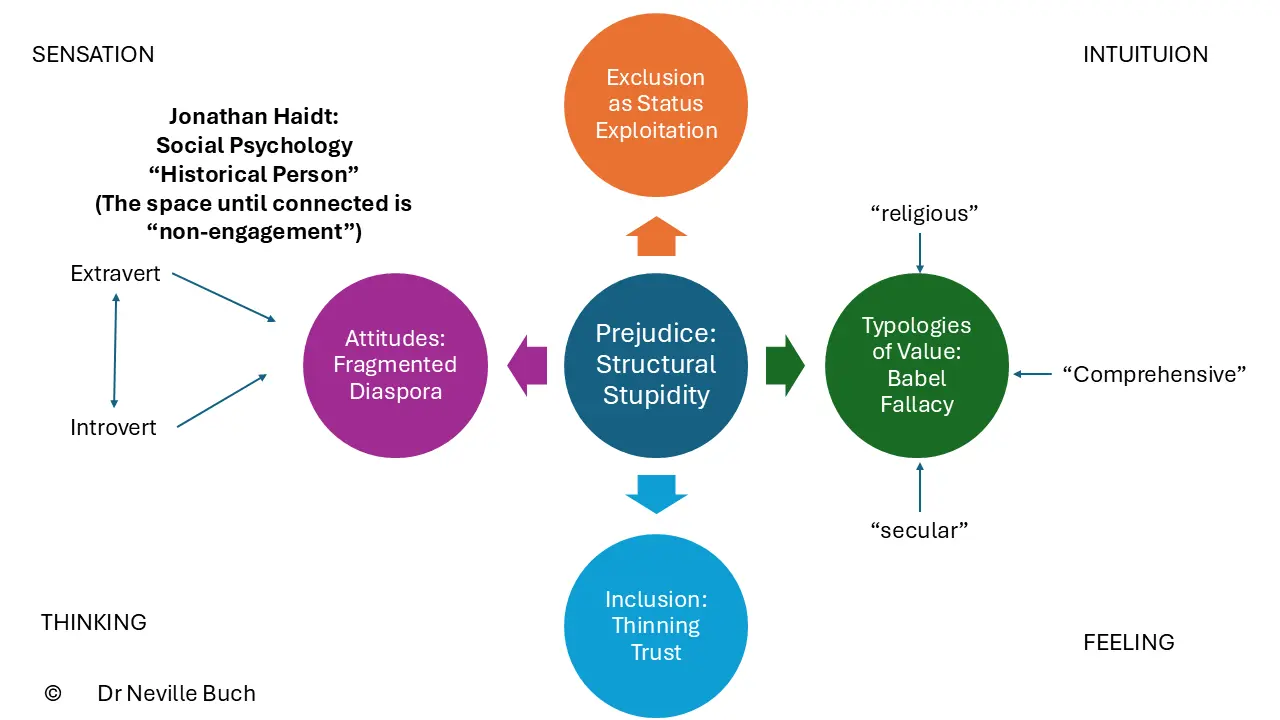
This essay explores the cognitive and sociological convergence between Dr. Jonathan Haidt and Dr. Neville Buch in their analyses of contemporary intellectual fragmentation. Both scholars identify a systemic breakdown in the ability of modern societies to maintain a shared reality, which Haidt characterizes through the metaphor of “Babel” and Buch defines as a “systemic cognitive pathology.” Points of connection are found in their shared critique of “structural stupidity,” the loss of institutional trust, and the “denoetization” of the individual by technological systems. However, disconnections emerge in their methodological origins and proposed remedies: while Haidt focuses on the social-psychological impact of social media’s “dart guns” and evolutionary scale cooperation, Buch emphasizes “Spiral Historiography” and the uncoiling of “Historical Forgetfulness.” Ultimately, Haidt identifies the technological medium as the driver of disorientation, whereas Buch identifies the lack of philosophical synthesis and the “techné mindset” as the underlying cause of intellectual wounds.
https://www.academia.edu/165822961/Jonathan_Haidt_and_DoC_Cognitive_Babel_and_the_Architecture_of_Systemic_Fragmentation
Featured Image:
Jack-Dzavid-and-Neville.-Three-Australian-Historians-1-May-2025.webp


Neville Buch
Latest posts by Neville Buch (see all)
- Part 3:The Failure of an Educational Institution and How to Spiral Forward – October 10, 2026
- Part 2:The Failure of an Educational Institution and How to Spiral Forward – October 10, 2026
- Part 1:The Failure of an Educational Institution and How to Spiral Forward – October 10, 2026